Sponsorship Is No Longer About Logos. It’s About Business.
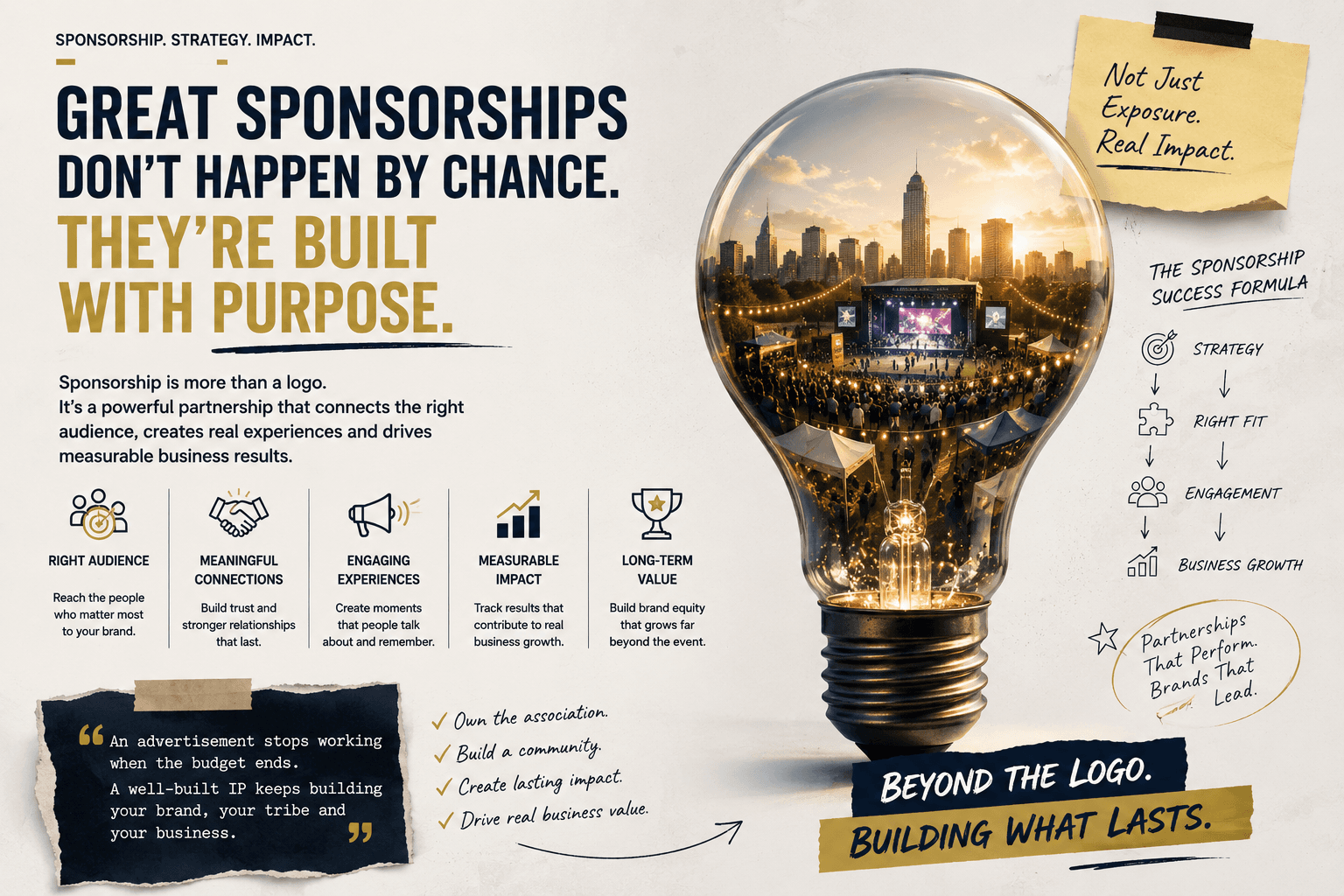
Sponsorship is no longer just about logo visibility. Today, brands need partnerships that deliver the right audience, meaningful engagement, measurable business impact, and long-term brand value. The future belongs to sponsorships built around strategy, activation, and shared growth, not just exposure.
For years, sponsorship was treated as a visibility game.
A brand paid for a logo on a jersey, a backdrop, an event banner, or a trophy and called it marketing.
But that model is changing.
Today, brands are asking a much harder question:
“What does this sponsorship actually do for my business?”
And that question is forcing sponsorship to evolve from a media-placement exercise into a strategic brand-building tool.
Industry research increasingly points in the same direction: sponsorship value is no longer measured only through impressions. Brands are looking at engagement, brand perception, customer relationships, hospitality, leads, sales and long-term brand impact.
The Problem With Traditional Sponsorship
The biggest mistake brands make is choosing a sponsorship because the property is popular.
Big audience ≠ right audience.
A property can generate millions of impressions and still deliver limited value if its audience doesn't match the brand's customers.
For example, a premium financial brand may get more value from a smaller golf or business-led property with the right HNI audience than from a mass-market event with significantly higher footfall.
The question shouldn't be:
“How many people will see us?”
It should be:
“Who will see us, what will they think about us, and what can we make them do next?”
From Visibility to Value
A strong sponsorship should ideally work across four layers:
1. Reach
How many relevant people can the brand access?
2. Relevance
Does the property naturally fit the brand's positioning and audience?
3. Engagement
Can the brand create an experience instead of simply displaying a logo?
4. Business Impact
Can the partnership contribute to measurable outcomes such as leads, sales, trials, customer acquisition, brand lift, or relationship building?
This is where sponsorship starts behaving less like traditional advertising and more like a business platform.
As Dentsu India recently noted, sports is increasingly moving beyond simply being an amplification channel toward deeper cultural participation.
The Rise of Activation
Buying sponsorship rights is only the beginning.
The real value comes from what a brand does with those rights.
Imagine a sports property where a brand gets:
Naming or category association
On-ground branding
Social media content
Influencer integration
Customer experiences
Lead-generation opportunities
Hospitality
Sampling or product trials
Data capture
Post-event content
Now the sponsorship becomes an ecosystem rather than a logo placement.
This is why activation matters as much as the rights fee.
A ₹50 lakh sponsorship with a strong activation strategy can potentially create more business value than a ₹1 crore sponsorship that simply puts a logo everywhere.
The New Sponsorship Playbook
The most effective sponsorship strategies are increasingly built around five questions:
Who is the audience?
Why does this audience matter to the brand?
What brand story can the property help tell?
What can the audience experience or do?
How will success be measured?
This approach also makes it easier for marketing teams to defend sponsorship investments internally.
Instead of saying:
“We sponsored the event because it was a big platform.”
The conversation becomes:
“We reached our target audience, created X interactions, generated Y leads, delivered Z content assets and improved brand consideration.”
That's a much stronger business case.
Sponsorship Is Becoming a Long-Term Asset
The biggest opportunity may be beyond one-off sponsorships.
Brands are increasingly looking at partnerships that can build long-term association and ownership.
Instead of sponsoring an event once, a brand can build an association around a recurring property, create a branded experience, develop content franchises and eventually build an owned IP.
That changes the economics completely.
An advertisement disappears when the campaign ends.
A well-built IP can continue to build community, brand equity, data, content and commercial opportunities over time.
The future therefore isn't simply:
Brand → Sponsor → Event
It is:
Brand → Platform → Community → Business Value
The Bottom Line
Sponsorship isn't dead.
Bad sponsorship is.
The brands that will win aren't necessarily the ones spending the most. They will be the ones that understand audience fit, strategic alignment, activation, and measurable outcomes.
The future of sponsorship belongs to partnerships where both sides know exactly why they are coming together—and what success looks like.
Because ultimately, a sponsorship should be more than “your logo here.”
It should answer one simple question:
“What business value can we create together?”
Let's Connect:
Kanhaiya@sponsiwise.com
+91 8076452536
Written by
Kanhaiya